Why Japanese Cars Last Longer Than European Cars
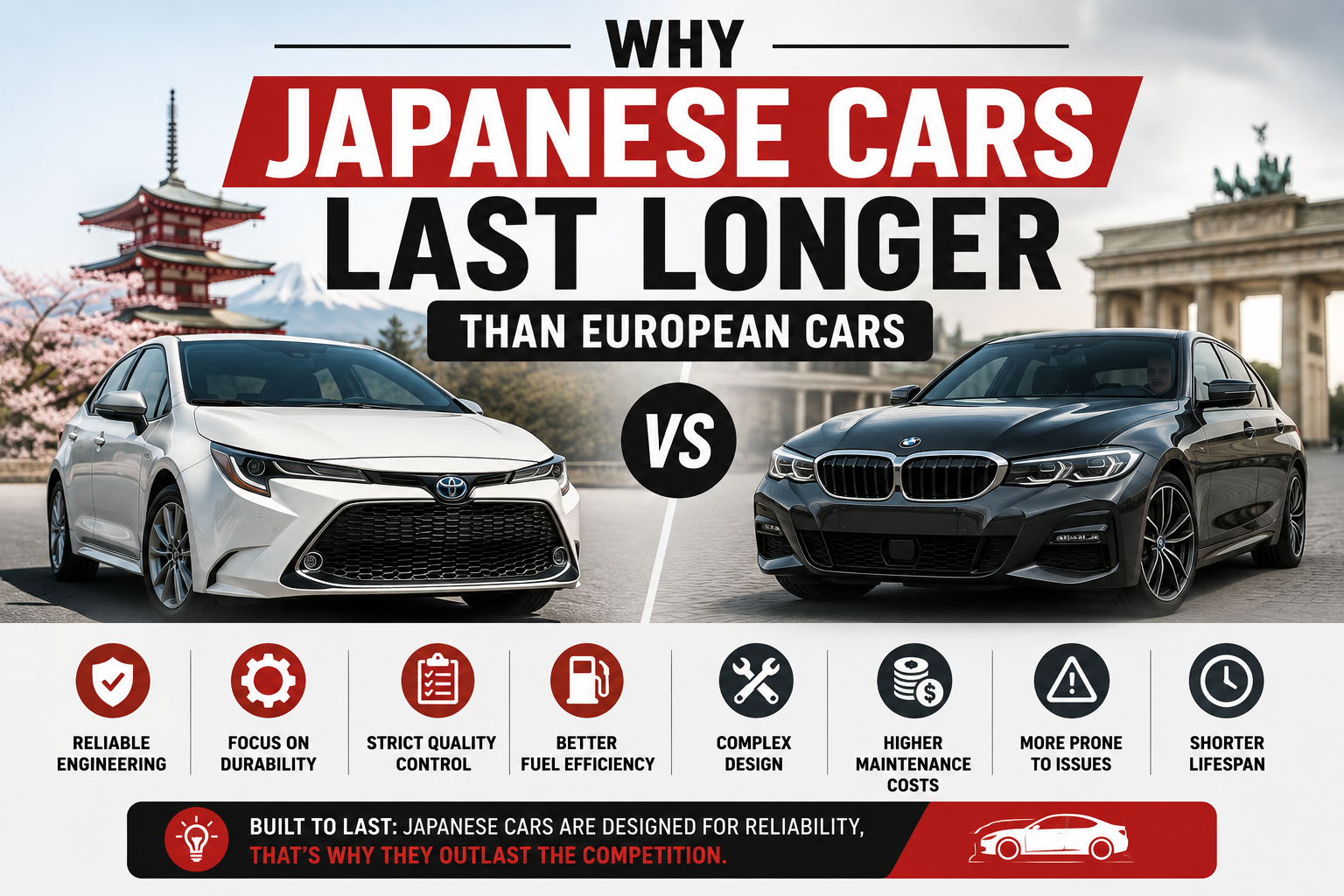
If you’ve spent any time around cars you’ve almost certainly heard some form of this exchange: Someone’s trying to choose between a Toyota and a BMW, or between a Honda and a Mercedes. And without fail someone will be in the room to say-Japanese cars last longer.
Is it true though? And if so, why?
The answer in short is yes-Japanese cars do last longer, on average. Not because Europeans don’t care or because they’re incompetent; but because the two industries developed with fundamentally different assumptions, philosophies, and criteria for what makes a great car.
This comparison of industries will also help you make a smarter buying choice, no matter whether you’re looking for something new or used.
The Philosophy Behind Japanese Manufacturing
The reason for the extreme reliability of Japanese cars can be found in the history of Japan’s post WWII manufacturing culture.
Japanese industry, including car companies, was rebuilt on a doctrine called Kaizen, a philosophy of continuous improvement that aims to eliminate waste, eliminate mistakes and constantly improve the process over time. Specifically Toyota developed a method of manufacturing, which eventually became known as the Toyota Production System. So successful was it, it is now taught at business schools worldwide.
The simple principle is build it correctly first time, every time. Detect problems early. Remove complexity where possible. Test the hell out of it before it goes to the customer.
This produced cars that were designed with the intention of being reliable first and foremost, not as an afterthought. Japanese engineers at Toyota and Honda are not only saying, “How can we make this a great car to drive”, but also “How do we ensure that this car will still be running after 300,000 kilometers.”
German (and other European) engineers were asking a different set of questions: How do we build this car to be powerful? Luxurious? Have fantastic driving dynamics? Be at the cutting edge of technology? All perfectly reasonable aspirations, which led to a wonderfully competent cars, but complexity, premature introduction of new technologies and more points of potential failure.
Simplicity vs Sophistication
Among the most pragmatic reasons for their longevity is that they have comparatively fewer components and simpler engineering under the hood-in broad terms- than most equivalently aging European alternatives. There is no insult here. The early 2000s, normally aspirated, Toyota Camry motor has far fewer parts, sensors, and systems that can be broken than a comparably dated, turbocharged BMW/Audi with an air suspension and high-spec electronics. This naturally means fewer things will fail, when they do they are relatively easier to find and far cheaper to repair/replace, and every mechanic from here to Timbuktu has experience with these simpler motors from the millions of examples on the road. European makes have often sought to do things more cleverly: turbocharged for more grunt from a smaller motor, air suspension for a “better ride,” advanced, highly-geared transmissions, dual-clutch boxes, etc. When it works these are indeed often ingenious technologies but they add an inherent complexity the simpler solutions do not possess. BMW’s N54 is a truly wondrous piece of engineering, but it is infamous for its wastegates, high-pressure fuel pumps, and cooling systems in the same way that Toyota’s 1GR-FE V6 is famous for running half a million KMs without any issue (on paper).
How They Handle Extreme Conditions
A second reason that Japanese cars were designed for exceptional reliability is a testament to where the cars were meant to be tested and proven. Japanese cars were always built in numbers sufficient for selling them in markets with extremely harsh conditions – heat, humidity, dust, poor roads, to name a few. Cars that are built for these conditions and proven to endure will be overbuilt in a manner that benefits owners in the long run. Toyota Land Cruisers, Hiluxs and Prados earned their reputation partly because they were being used in extremely adverse conditions by organizations that could not have cars fail – NGO operations, militaries, mining companies and farming in remote areas where the failure of even a single sensor could be hours from even getting it to the nearest shop. The European cars, especially the expensive German ones were designed largely for the European road environment-better roads, moderate temperatures and access to authorized shops with technicians and correct parts. While this design approach is not flawed at home, it becomes a comparative weakness when imported to hotter, more dusty environments with fewer specialist services.
The Long-Term Cost Reality
Reliability isn’t really about whether or not the car will get you from A to B; it’s about what it costs to keep it running reliably for five, ten, or fifteen years.
And it is here where the dichotomy between Japanese and European vehicles becomes glaringly apparent in the real world. A used Toyota Camry or Honda Accord will almost always cost you less in terms of maintenance and parts (since everyone knows what to do and where to get them), and will usually require less time at the workshop. A 5-series BMW or E-Class Mercedes at a comparable purchase price will probably cost more in terms of spare parts and specialist labor that are more difficult and complex to diagnose, plus intervals that equate to a substantially higher annual expenditure.
This isn’t to say that the European vehicle isn’t a good purchase, it’s just that its’ a different ownership proposition. If you’re purchasing a brand new BMW under full warranty and trading it in prior to the expiry of this warranty then the gap in reliability becomes less important. If you’re purchasing a used car that’s already 5-years old and intend to run it on for the next 5-years, then the cumulative ownership cost difference between a Japanese car and a European one at similar purchase price points can be very significant indeed.
Where European Cars Still Win
I’d feel dishonest trying to represent this as a totally one sided affair. It’s worth pointing out that European, and especially German, cars have some distinct advantages which the Japanese are still, generally struggling to catch up on.
Driving dynamics. That wonderful sense of communication you get with a perfectly sorted BMW or Mercedes, the steering feel, the chassis balance, the connection between the driver and machine is something Toyota and Honda has never quite concentrated on in the same way. If you care about driving for driving’s sake then the European cars deliver in this department in a way the Japanese ones can’t.
Quality of interior trim and styling in European premium cars is generally second to none as well. Material choices, layout, the actual aesthetic of the interior is an area that has had strong benchmarks set by brands such as Mercedes and Audi.
Adoption of new technology. Europe as a whole has had a better track record of bringing new features to market earlier (not always with perfect reliability in the very first few years, but nonetheless) driving forward advancements in safety, performance engineering and premium features.
So Which Should You Choose?
If your main concerns when purchasing (especially in a second hand car) are long term reliability, long term running costs and many years peace of mind of ownership, the most practical choice for the average person would be a Japanese vehicle.
If you are prepared to pay more in maintenance for a European model, and if in-car quality, driveability and the badge over and above all else- a European could be worth the extra cost of ownership for what you get out of it.
There is no correct or incorrect answer here, only the realistic evaluation of individual priorities.
What is not good value is purchasing a used European car at a second hand Japanese price, expecting a similar cost of ownership. The initial cost is only one component of a cars cost of ownership; over many years of ownership the ongoing costs can be just as great and this is why Japanese vehicles have continually built themselves such a good name.