
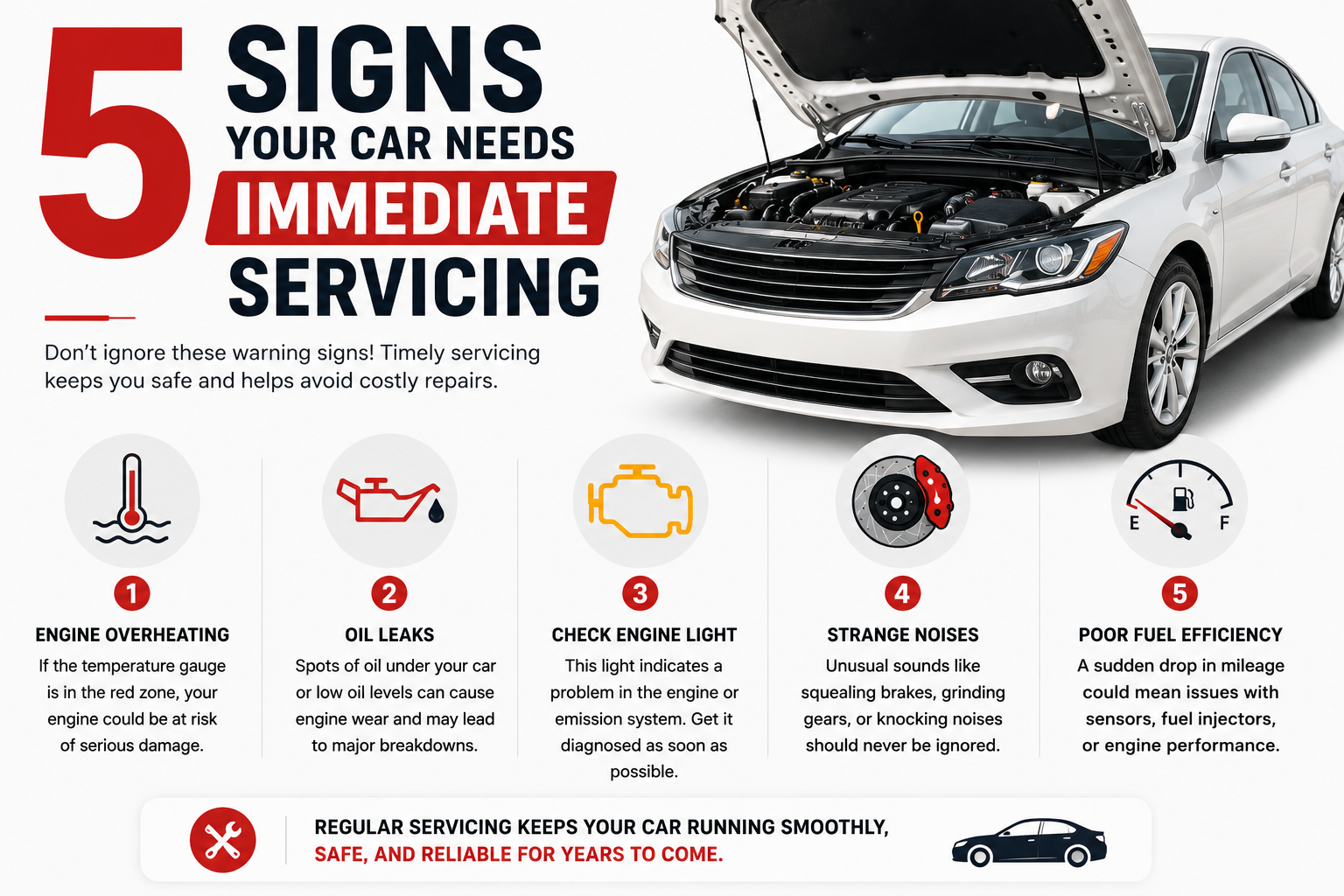
5 Signs Your Car Needs Immediate Servicing
Most people only think about servicing their car when something goes visibly wrong — a warning light that has been glowing for three weeks, a noise that has gotten too loud to ignore, or a friend who finally points out that the car is leaking something onto the driveway.
And here is the issue with that-once you can easily notice your car problem has occurred, your car’s condition has more than likely exceeded its potential to be an easy inexpensive fix at the proper time, and thus has become an enormous repair requiring much greater expenses, and extended absence from road operation.
Actually, most cars are rather excellent in alerting you when something is wrong. All that is needed is knowing what to listen for- and more importantly, what to take seriously.
This article will present you with the top five warnings your car needs serviced immediately. If your car has presented any of these warning signs, don’t delay!
1. Strange Noises That Were Not There Before
Again, this sounds obvious, but people rarely pay attention to this the most. Humans get used to new sounds faster than you might think. That tiny knocking can soon become background noise and that little screech when you apply the brakes becomes something you learn to live with until eventually a noise that should have landed you in a workshop three months ago has become part of the norm.
Various sounds suggest various types of problem. A high-pitched squealing or grinding noise when you apply the brakes usually indicates worn brake pads that are in need of changing. Not only will it lead to you being vulnerable if you fail to take it to a workshop, it can start to damage the brake rotors which will not only cause significant additional expense (from a SAR 200 replacement part, it’s likely to end up being closer to SAR 1,000), it could lead to further mechanical damage and much greater costs if left unattended. A knocking sound coming from the engine, particularly when you accelerate, generally suggests some sort of problem with a part of the engine such as low oil pressure, worn bearings or some problem with fuel ignition. A clicking sound when turning the wheel typically suggests a problem with a CV joint or the power steering system. The simple rule of thumb here is; if there’s a noise that wasn’t there before and didn’t use to make that sound, your car is trying to tell you something so take note.
2. Warning Lights on the Dashboard
These new vehicles come with highly advanced onboard diagnostic systems that continuously monitor everything from the condition of the engine through to the pressure of the tyres. If one of these items falls outside acceptable operating range then a warning light will display on the dashboard.
Too many drivers see a warning light appear on the dashboard, then search for ways to discount it as being a problem which may not be serious enough to address, for example, many drivers will let the engine check light burn bright orange for many months, reasoning it may be nothing major.
In reality the engine check light can be indicating any number of problems, some of which could easily cause extensive damage to your engine if not addressed quickly. This can only be discovered by connecting a diagnostic tool to the vehicle. Many garages will be happy to do this at very little expense to yourself.
The only lights which should not be ignored even for a day are the oil pressure, engine temperature and battery warning lights; these all relate to factors that can quickly damage the engine considerably if the vehicle is used.
If a warning light appears, do check your owners manual, and act upon what the warning means. Do not simply ignore the warning light.
3. The Car Is Handling Differently Than Usual
You are so used to how your car normally feels to drive. You’ve driven it for hundreds or even thousands of miles. When it changes to the feel of how you’d normally expect, and even though you cannot tell exactly what, the feeling is one worth noting.
Pulling to one side while travelling in a straight line, while not a catastrophic thing, is a tell-tale sign of a number of possible issues, such as uneven tyre wear, wheel alignment problems, or potentially brake wear where the pressure isn’t distributed correctly on both sides and as you travel your car pulls in one direction; which, as well as feeling very annoying to drive, will wear out your tyres quicker.
Vibration felt throughout the steering wheel or seat of the car when travelling at certain speeds, often means either the wheel balance requires attention, or perhaps a suspension component is wearing out, or the drivetrain is experiencing a fault. While the steering feels much heavier than it should do and requires you to pull to turn it, either a fluid issue with the power steering is the most likely, or there’s an underlying problem.
Feel the brakes in the car and notice if the pedal feels spongy to push or requires much more pressure to stop the car than is normally necessary, this is a handling difference that must be dealt with without delay. This is fundamentally a problem of control.
Basically, any substantial change to the way that your car feels on the road when driving is going to be a sign that there has been a change on a mechanical level, deal with it.
4. Fluid Leaks Under the Car
If you park your car in the same place everyday and start to see a stain or puddle on the ground where the car was parked, you have a leak. It sounds like it’s obvious but people actually observe this problem and file it away to consider later.
Different fluids can mean different things. An oily, dark brown to black stain is usually engine oil. A red or brown fluid usually found toward the front of the car may be power steering or transmission fluid. A light yellow or clear liquid around the wheels is probably brake fluid; this is usually one of the more dangerous leaks you can have. Coolant has a sweet smell to it and can be one of several colors including green, pink, or orange depending on what kind of coolant is used.
A small slow leak can grow over time and become a bigger issue. If you have low oil you will cause excessive friction and wear on internal engine parts. If you have low coolant, the engine can overheat. If you have low brake fluid the performance of your brakes can be effected significantly. None of these issues do you want to learn about at the wrong time.
If you notice a fluid under the car, check your fluid levels immediately and take the car to the shop. The leak will not repair itself.
5. Increased Fuel Consumption Without Explanation
If you’ve had your car for a while, you have a fair idea of how many miles it does between full tanks of fuel. When this figure starts decreasing to a point that you have to fill up more frequently for the same length of journey then it’s time to address what’s causing your engine to lose efficiency.
There are numerous things that can contribute to loss of fuel economy, these include: a blocked or dirty fuel injector reducing efficiency of combustion; an oxygen sensor which is causing the engine management system to incorrectly calculate the correct fuel mixture; worn out spark plugs creating inefficient combustion; a blocked air filter supplying insufficient air for combustion to occur effectively; even tyres with too little pressure.
The great thing about falling fuel economy, although I guess it isn’t great, is that it rarely appears on its own; it’s usually the first sign that something on the car hasn’t been checked in a while and that mechanical fault could be on its way. Taking care of it will often improve economy and catch other problems in their infancy.
In summary, if you’re noticing a significant and consistent loss of fuel economy it’s worth having your car checked – if only for your pocket, but for the benefit of your engine.
The Bottom Line
The car is sending you a message, that it requires maintenance. The noise it makes, the way it drives, the indicator lights that flash on, the puddles beneath it when parked-all these are the way the car is saying, “I’m having trouble”. It is a matter of just being slow to hear, that turns an inexpensive minor service, into a massive, costly repair.
Any of the symptoms shown here, does not get better over time-it can either stay the same or deteriorate further. Acting sooner, will always save the car owners, repair money, while providing reliability and safety.
If you recognize any of the following symptoms of a troubled car, the time to have a service, booked is today.