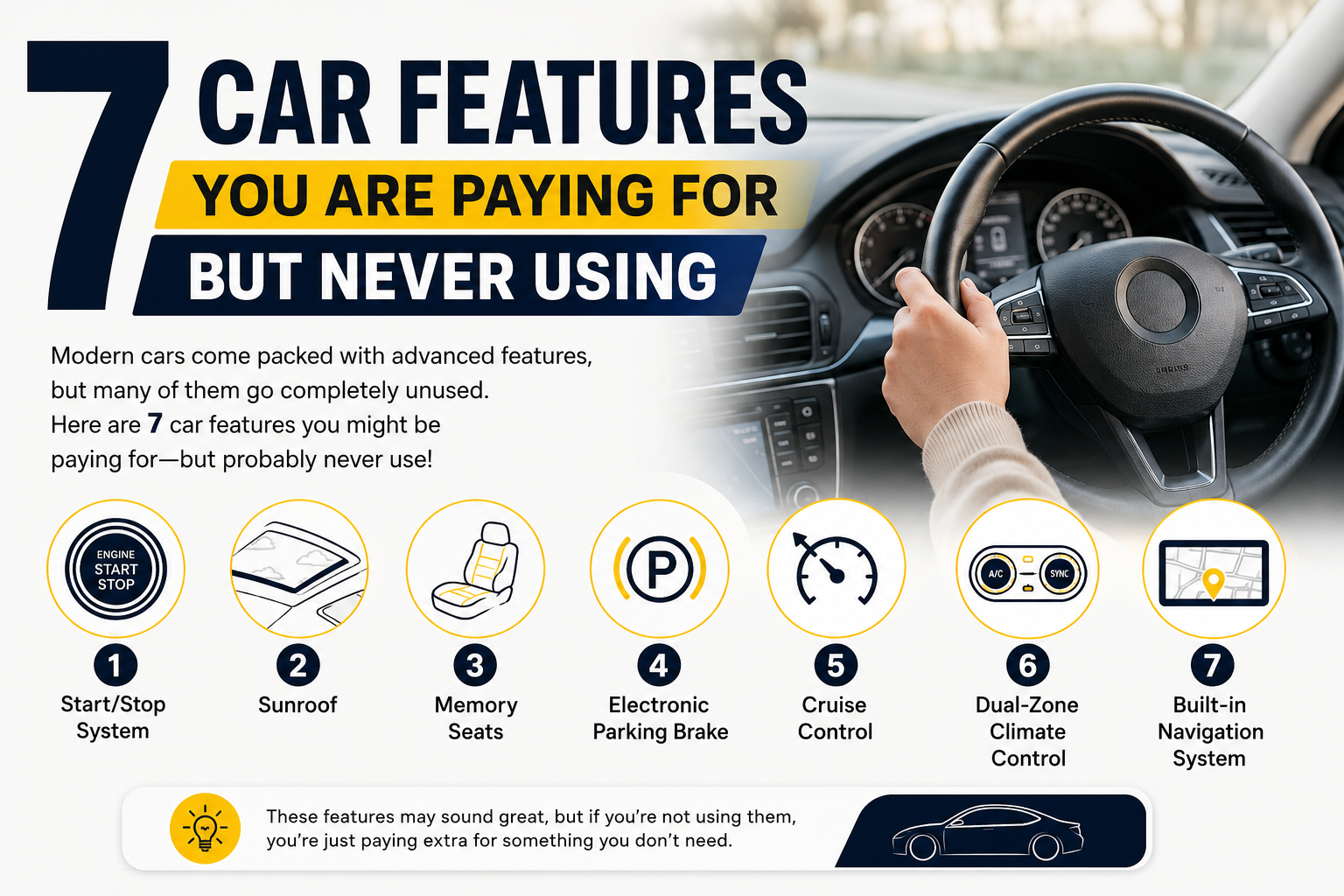
7 Car Features You Are Paying For But Never Using
You walk onto a lot, begin spec’ing a new car, and you’re hit with a laundry list of features. Panoramic roof. Heads-up display. 360-degree cameras. Massage seats. Premium sound system. All of them jack up the price, and all of them seem perfectly compelling while sitting in a spotless showroom.
The trick is that dealerships work really hard to make every feature seem mandatory. The day-to-day reality is much different. Very few of us ever actually take advantage of all the technology crammed into our cars, and a good number of the options that made it into the final purchase price never see the light of day.
Here are seven options a lot of buyers end up paying for and then virtually never using. So before you shell out for that new car, or before you consider splurging for that top-of-the-line trim package, take a read.
1.The Premium Sound System Upgrade
Nearly every automaker gives you the choice between a standard sound system and a more expensive one as an optional extra or as part of a higher trim. Bose, Harman Kardon, Bang and Olufsen, Burmester… the names are alluring and the in-showroom demo at reasonable volumes with precisely selected tracks always sounds superb.
The problem for most drivers is the gap between the standard sound and an expensive upgrade is much smaller than is actually noticeable in a silent showroom. Much smaller indeed when the rumble of the motorway, the hiss of wind, and everything else involved in driving are all competing to be heard within the car’s cabin.
Driver behavior studies consistently show that for the most part, drivers simply listen to music at a medium volume on their commutes, and are regularly interrupted by the likes of phone calls and sat nav directions. An audiophile would notice and appreciate the very small improvement in sound from a premium sound system in this environment, but most drivers would simply not.
An audiophile who uses the commute purely as a time to have a relaxing drive with no other distractions with the aim of solely enjoying music might well consider the extra money well spent. For the vast majority of owners, however, the standard sound system in most modern cars is perfectly adequate, and this is one of the cheapest things to dispense with when ticking the options on a new car.
2. Adaptive Cruise Control and Lane Keeping Assist
One that might catch people out as they look so useful – and in theory they are.Adaptive cruise control that keeps a safe distance for you; lane keeping assist that gently nudges you back into your lane. On a long stint up the motorway, these really sound like heaven.
However, it’s common to find that drivers turn these off within the first month of ownership, and don’t use them again. The lane keeping system in particular tends to get a little argumentative in roundabouts, on bends and on any road markings that have become slightly blurred (which you’d be surprised how many of them do). Many drivers simply find the tiny steering inputs more irritating than the benefit you’re supposed to be getting.
Adaptive cruise control does work brilliantly in clear traffic flow on a clean motorway. In dense city traffic, with multiple lane changes or exits, on bumpy roads or when the cameras can’t see clearly (in driving rain, bright sunlight or when the markings have faded), the trouble it causes often outweighs the effort of simply driving it yourself.
They do significantly add to the price of a car; make sure you consider honestly how much motorway driving you actually do and if your driving style would even benefit.
3. The Panoramic Sunroof
The panoramic sunroof is one of the most perennially popular new car specification additions. They look nice on a brochure photograph and let light into the cabin. On a sunny day in a showroom it feels utterly luxurious to slide one open. But the majority of the time when it’s on your driveway in day to day use the panoramic sunroof will be closed. In a hot country driving with it open just makes the cabin unbearably hot which puts the air conditioning on max and reduces fuel economy, at which point you immediately slide the roof cover open so you can just feel the sun through a screen but see absolutely nothing through the glass roof above it. It stays shut for months on end in cold, wet countries. On top of this you have the little practical problems the dealership will not highlight for you. Panoramic sunroofs add a weight penalty at the top of the vehicle, and they tend to get wind noise eventually and the repairs for any glass cracks or seal failure can be quite significant. They will also result in slightly less headspace which affects taller occupants in the back. The actual number of hours during a cars life that its owner is enjoying the panoramic sunroof seems to be amazingly small given how much it adds to the cost.
4. Heads-Up Display
This is the heads-up display. Information – the current speed, the next instruction, various warnings – are projected onto the windscreen, within your forward view. The logic is that you never have to take your eye off the road to glance at your speed or the next turning.
Sounds terrific. The reality is that many drivers stop using it within a few weeks. It can be extremely difficult to see in direct sunlight. Some drivers also find it distracting. Polarised sunglasses, quite common in hot climes, cause the display to disappear entirely.
Most drivers become accustomed to glancing down at the instruments, which takes not much more than a fraction of a second and has been perfectly acceptable for the past century of motoring. The heads-up display solves a problem which the majority of drivers don’t actually have.
5. Massaging Seats
Massaging seats appear on the options lists for both premium and luxury models and they sounds like a proper indulgence – and that is precisely how they are marketed. Vibrating backrest, kneading operation, adjustable settings for the strength of the massage; in a vehicle costing upwards of 200,000 SAR, they seem like a feature that is quite appropriate.
In reality however, for the most part they will be used during the initial novel phase of ownership and then largely forgotten. In most production cars the massage function is extremely subdued-nowhere comparable to an actual massage, and on a bumpy road it becomes largely indistinguishable from the bumps themselves.
Perhaps more critically, for the vast majority of people, the journey time each day is just not sufficient to get any benefit. A commute of ten to fifteen minutes is hardly long enough for the system to accomplish much. It is on a very long journey that the seats could actually perform usefully, although these tend to be rare events for the average owner.
6. The 360-Degree Camera System
In the case of cameras being present on nearly all new cars, it’s true that the simple reversing camera is probably the most practical new safety addition in years. It’s hardly controversial to admit that.
The 360-degree bird’s eye view system, on the other hand, that which stitches images from cameras on each of the car’s sides together to produce a view from directly overhead; many customers pay extra for the option and subsequently find themselves not using it nearly as much as they had assumed. Most drivers, having found the 360 view appealing at first, end up using mainly the rear view camera and mirrors for the overwhelming majority of parking scenarios. The 360-degree system adds context to really tight spots or when manoeuvring around obstructions at very low speeds but such occasions only account for a small proportion of every day use.
7. Built-In Navigation Systems
This feature is nearing becoming redundant, as a paid extra, but companies continue to demand and get money for it. The onboard satnav on most cars is an expensive optional extra, or is part of a top of the range pack, its maps must be purchased in an updated form, it is a slow, cumbersome interface to use that consumers are not accustomed to compared to their smartphones, and is always lacking compared to that already found in the phone in their pocket, which comes free in the shape of Google Maps, or Apple Maps, always updated, always correct, always showing the traffic conditions, always improving, and that can already be plugged into, or paired up wirelessly with the dashboard display thanks to CarPlay or Android Auto, now also an almost ubiquitous, or cheap, standard feature. Paying for an original manufacturer’s satnav in 2026 is, for nearly every driver, a foolhardy and unjustifiable expenditure.